
Overview: Redesigning How Creative Talent Gets Hired
Werc is a Saas platform that transforms how creative talent gets discovered and hired. I collaborated with the founding team on research, design systems, and interactive prototypes to redesign the entire platform, making talent discovery faster and portfolios more expressive.


In this project, I worked in a 6 people team collaborating directly with the founding CEO, and engineers.
People behind
Eylul (Junior UX Designer)
Nada Bulbul (PM)
Yigitalp Konuksever (ML Eng)
...
Timeline
9 months
Toolbox
Figma
Talent Discovery in Hours, Not Weeks
Werc transforms how creative talent gets discovered and hired by enabling producers to find qualified talent in hours instead of weeks, and allowing creators to showcase the depth of their work beyond static profiles.
Talent Discovery in Hours, Not Weeks
Werc transforms how creative talent gets discovered and hired by enabling producers to find qualified talent in hours instead of weeks, and allowing creators to showcase the depth of their work beyond static profiles.

The Challenge: A Creative Platform with No Creativity
Producers run crews of hundreds against impossible deadlines, yet still hunt for talent in spreadsheets and LinkedIn. The old Werc made it worse. Everything was text: job posts you had to wade through, the action that mattered buried at the bottom. Profiles read like résumés, with no reel, no proof, no sense of how anyone actually shot. Crew sat in database rows, four per page, careers flattened into strings of text. A platform built for creatives that showed none of the creativity. Which left one question: How might we create a platform where cinematographers can showcase their creative work visually?
The Challenge: A Creative Platform with No Creativity
Producers run crews of hundreds against impossible deadlines, yet still hunt for talent in spreadsheets and LinkedIn. The old Werc made it worse. Everything was text: job posts you had to wade through, the action that mattered buried at the bottom. Profiles read like résumés, with no reel, no proof, no sense of how anyone actually shot. Crew sat in database rows, four per page, careers flattened into strings of text. A platform built for creatives that showed none of the creativity. Which left one question: How might we create a platform where cinematographers can showcase their creative work visually?

Research: Three Failures UI Tweaks Couldn't Fix
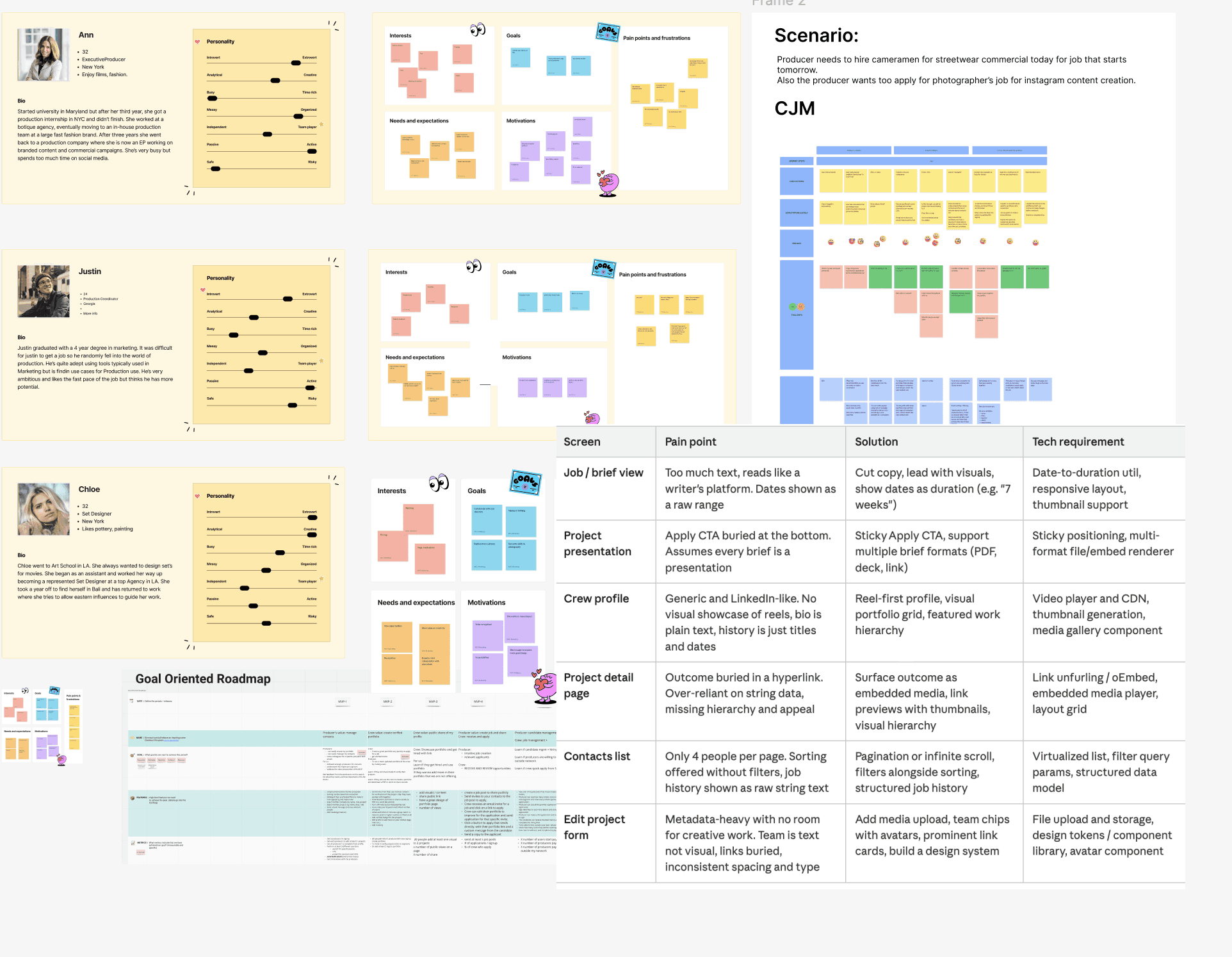
We interviewed producers and cinematographers and found both trapped in an outdated system: producers spent hours assembling crews from fragmented sources, while cinematographers felt invisible on LinkedIn. Analyzing how producers actually hire revealed three failures UI tweaks couldn't fix: broken discovery, portfolios that didn't reflect real work, and manual crew matching. So we prioritized ruthlessly: visual portfolios, instant matching through the "people I worked with" page, and no more spreadsheets.
Research: Three Failures UI Tweaks Couldn't Fix
We interviewed producers and cinematographers and found both trapped in an outdated system: producers spent hours assembling crews from fragmented sources, while cinematographers felt invisible on LinkedIn. Analyzing how producers actually hire revealed three failures UI tweaks couldn't fix: broken discovery, portfolios that didn't reflect real work, and manual crew matching. So we prioritized ruthlessly: visual portfolios, instant matching through the "people I worked with" page, and no more spreadsheets.
Visuals Forward, Networks at the Center
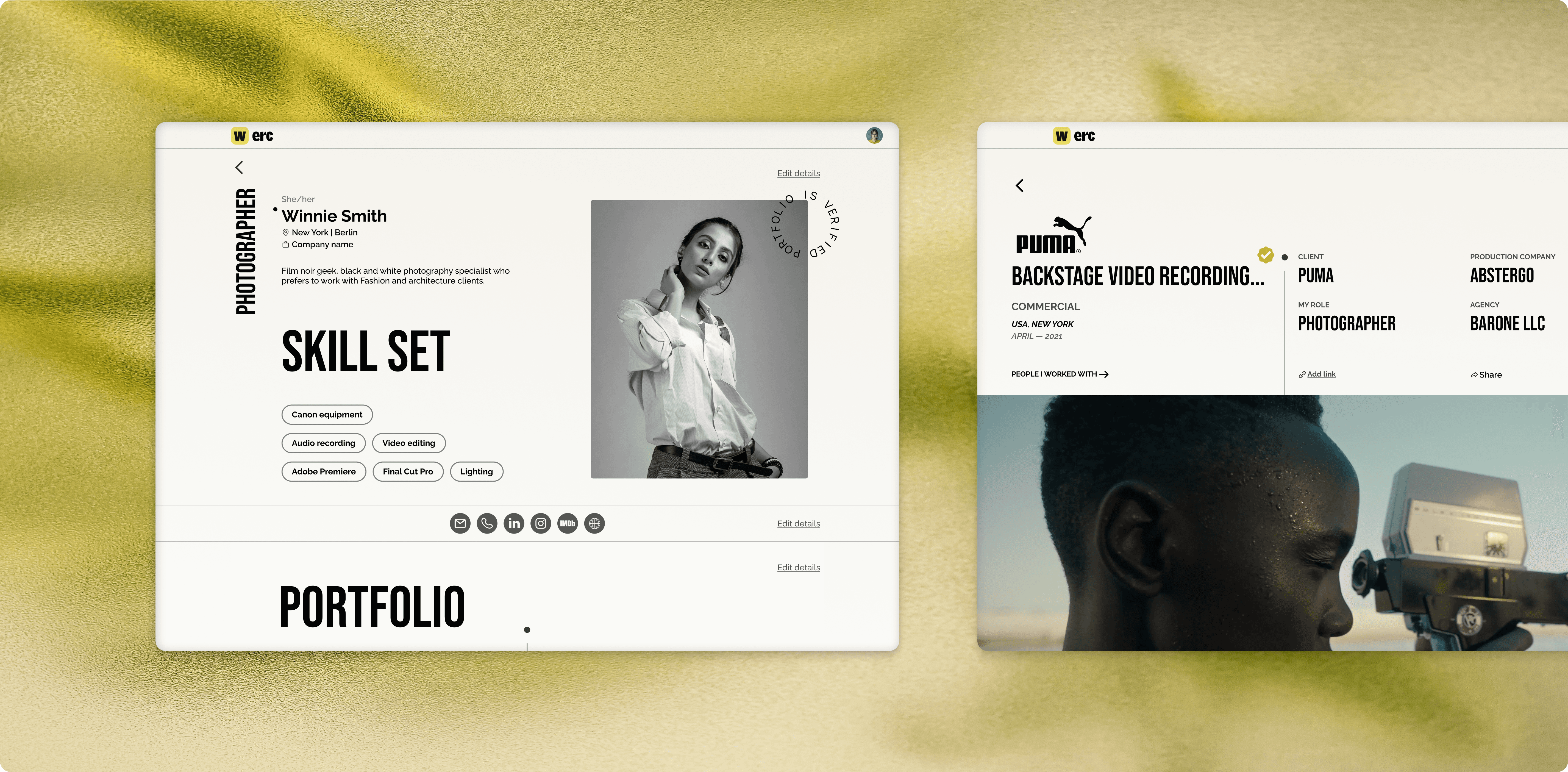
The aim of redesign was to max data-ink ratio by removing redundant text. Instead we brought visuals forward. User research revealed people get jobs from their networks so People I Worked With became an important page to design.
Visuals Forward, Networks at the Center
The aim of redesign was to max data-ink ratio by removing redundant text. Instead we brought visuals forward. User research revealed people get jobs from their networks so People I Worked With became an important page to design.

I mapped the platform into one system diagram, every page, connection, and component, so engineers had a build reference and the whole team shared one view of the product.
I mapped the platform into one system diagram, every page, connection, and component, so engineers had a build reference and the whole team shared one view of the product.

Design System: One Language to Build in Parallel
Given the project's scale and collaborative nature, a unified design language was essential. We developed a comprehensive design system in parallel with the early mockups to keep everything consistent and efficient.
Design System: One Language to Build in Parallel
Given the project's scale and collaborative nature, a unified design language was essential. We developed a comprehensive design system in parallel with the early mockups to keep everything consistent and efficient.


Shipped: Crews Built in Hours, Craft Finally Visible
Redesigned Werc fixes three core failures. Broken discovery is solved by the "people I worked with" page, surfacing real connections instead of dead-end searches. Flat portfolios become visual-first, raising the data-ink ratio so media leads and work is finally visible. Manual matching is automated: producers upload a spreadsheet of crew names and Werc returns those people with their real portfolios. Rebuilt end to end, with transparency and user-centric development driving adoption in testing. The result: producers build crews in hours, not weeks, and creatives finally showcase their craft.
Shipped: Crews Built in Hours, Craft Finally Visible
Redesigned Werc fixes three core failures. Broken discovery is solved by the "people I worked with" page, surfacing real connections instead of dead-end searches. Flat portfolios become visual-first, raising the data-ink ratio so media leads and work is finally visible. Manual matching is automated: producers upload a spreadsheet of crew names and Werc returns those people with their real portfolios. Rebuilt end to end, with transparency and user-centric development driving adoption in testing. The result: producers build crews in hours, not weeks, and creatives finally showcase their craft.
Tight collaboration carried Werc. Clear prioritization and a shared design system let us work in parallel, updating every module over several months, from small UI fixes to full redesigns. We stayed close to development to keep designs feasible and aligned with stakeholders on user needs and business goals.
Tight collaboration carried Werc. Clear prioritization and a shared design system let us work in parallel, updating every module over several months, from small UI fixes to full redesigns. We stayed close to development to keep designs feasible and aligned with stakeholders on user needs and business goals.


Outcome: 2 Weeks to 3.5 Hours
We tested with 22 producers and 14 cinematographers. Crew assembly dropped from 2 weeks to 3.5 hours per role, and 19 of 22 producers completed the upload, extract, and find flow unassisted. The "people I worked with" page changed navigation: 75% reached a candidate through a shared connection rather than search, validating our research insight. Nearly all engaged with a media asset, versus the old text-only layout.
Outcome: 2 Weeks to 3.5 Hours
We tested with 22 producers and 14 cinematographers. Crew assembly dropped from 2 weeks to 3.5 hours per role, and 19 of 22 producers completed the upload, extract, and find flow unassisted. The "people I worked with" page changed navigation: 75% reached a candidate through a shared connection rather than search, validating our research insight. Nearly all engaged with a media asset, versus the old text-only layout.


Back
eylulyildirimisnow@gmail.com